
The real AI bubble
“Maybe AI can help us with that?”
- Some guy in a meeting

Bubbles
2021
2021 was a weird year. I spent most of it living alone in a Brooklyn apartment, working remotely, squeezing as much enjoyment as possible out of occasional hangouts with friends. It was an isolating era for me and many others. What to do with all this empty time?
The answer: trade meme stocks. The memes on WallStreetBets were so entertaining that I rode the hype train on GameStop, Dogecoin, and several other silly trades. In Jan 2021, A high school friend who I hadn’t talked to in years texted me “💎🙌?” with no preamble or context.
At one point, I walked over to a nearby barber shop to get a haircut. The barber talked about starting his business and the ongoing revitalization of the area. Then he started talked about trading NIO, a Chinese EV stock that 10x’d its price in under 6 months.
I should’ve known that was the start of the end.
1929
An apocryphal story: Joseph Kennedy, Sr.—JFK’s dad—got his shoes shined in 1929. The shoeshine boy started giving the elder Kennedy advice for which stocks to trade. Joe liquidated his stock portfolio, reasoning that this was a sign of too much hype in the markets. The market crash followed soon after.
2025
2025 has also been a weird year. In technology and the markets, the vibes around AI are overwhelmingly positive—so positive that it makes professional investors nervous.
In my job as a software engineer, things feel dramatically different than in the past. I’m working on a two-person startup where we’ve been able to build a lot—quickly, with high quality, and profitably. I’m building features and fixing bugs by Slacking an AI agent while I’m on the subway.
I worked at an applied AI company this summer. I went to get a haircut, and the barber started asking me about AI. He was curious and asked great questions.
“Do you use AI much?” I asked him.
“Yeah, I prefer Claude. I used it recently to learn how to negotiate buying a new car. I had it walk me through what questions to ask. I don’t know how I would’ve done it before.”
The value feels real, and yet, I’m nervous.

Computing
I think generative AI is just one phase of a broader trend: the computing revolution.
Consider electricity. The earliest versions of electric technology started to emerge in the mid-1800s. Real-world applications started around the turn of the century, and the 1900s saw increasing adoption of electric technology, ranging from electric grids to home appliances to modern batteries that enabled technologies like the iPhone, drones, and EVs. The electric revolution is mature, but still in progress.
Computing emerged in the mid-1900s. We’re less than 100 years into its trajectory, and the simple truth is that most people still don’t understand its profundity.
Yes, it’s been 15 years since Marc Andreessen’s Software is Eating the World essay. Everybody has a computer in their pockets. But if you go talk to people in older organizations—governments, manufacturers, hospitals—they still don’t deeply understand data and code.
LLMs are revolutionary new tool that have emerged in recent years, but they’re only useful in conjunction with curated data, clear thinking about user workflows, and a focus on the outcomes you’re actually trying to achieve.
Unfortunately, to most people, computers are purely arcane magic. The ubiquity of chatbots—and our tendency to anthropomorphize them—only deepens the mysticism. All this only muddles things further.
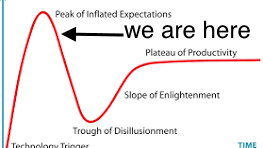
I’m AI, and I’m here to help
Hence the line that really bothers me: “Maybe AI can help us with that?”
It’s something I’ve heard people literally say multiple times in the past year, at older organizations where data is messy, computing fluency is low, and there are no in-house software engineers that can provide guidance or expertise. For most of these problems, there are ways in which “AI can help,” but it’s by no means a silver bullet.
But executives and investors are convinced that they need to “do AI,” and it’s politically risky to tell them to their face that their ideas are silly. So the distorted view of reality propagates. There’s no incentive to seek or speak the truth.
What does this actually mean for the markets, valuations of AI companies, or trajectory for the technology? It’s very hard to say.
All I know is that truth eventually prevails. The 1929 shoe-shine boy and my barber from 2021 had to learn—painfully—that they just got swept up in a hype cycle.
Whenever it happens, what’s needed is a bursting of the AI bubble in people’s minds—a recalibration where executives are no longer pursuing “AI initiatives” just because they’re supposed to, and everyday operators aren’t hoping that AI will magically solve their problems.
Perhaps then we can start focusing on the ways in which these technologies—a fresh, exciting wave of progress in the broader computing revolution—can truly change things.